Utility Billing
Iowa Solar Credit Cash-Out: Why Your January or April Reset Depends on the Tariff
The annual reset date matters, but the tariff determines what happens to the balance. A credit on a bill is not automatically a check owed to you.
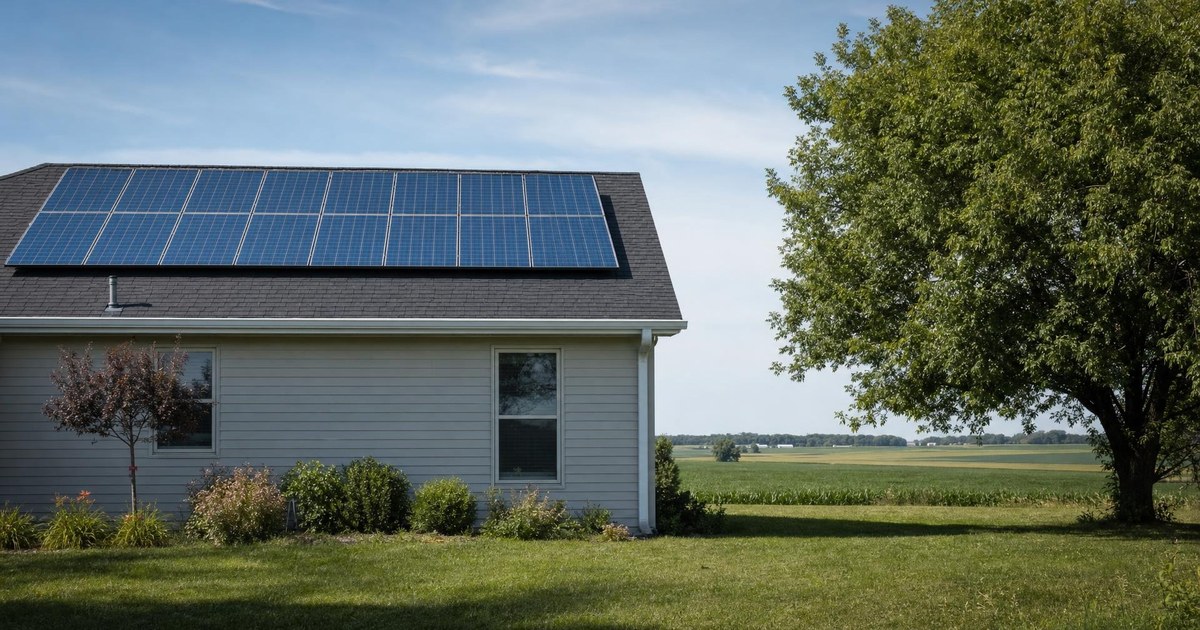
An Iowa homeowner can build up solar credits, reach the annual reset and discover that the balance does not turn into the payment expected from the sales presentation. Before treating that result as a billing error, identify the tariff and the type of credit on the account.
January and April are meaningful dates in Iowa's distributed-generation framework. They do not produce the same outcome under every billing arrangement. The Iowa Utilities Commission directs customers to the governing law and utility tariffs; its framework should not be read as a promise that every Iowa solar account receives an annual check.
Cash-out and forfeiture are different outcomes
The 2026 codification of Iowa Code section 476.49 distinguishes net billing from inflow/outflow billing. The currently posted MidAmerican tariffs discussed below retain that distinction. Its net-billing provisions describe an avoided-cost cash-out with proceeds divided between the customer and energy assistance. Its inflow/outflow provisions instead address forfeiture of remaining purchase credits at the annual reset. Both refer to a January or April election.
That distinction should appear in the savings explanation before anyone describes a surplus as income. Ask the utility for the rate code on your account and the document recording your annual-period election.
MidAmerican shows why the tariff name matters
MidAmerican's currently posted Iowa tariff includes a legacy PG Pilot cash-out provision. It values remaining private-energy credits at the specified avoided-cost calculation, generally divides the proceeds equally between the customer and its I CARE assistance program, and places the customer's portion on the bill. The tariff permits a larger assistance allocation by election. This is not a promise to pay the entire retail value of unused credits.
MidAmerican's Rate IO, available for eligible complete applications filed on or after December 1, 2020, uses a different rule: unused outflow purchase credits are forfeited at the selected annual reset. The tariff also states that a legacy customer switching to IO cannot later return to the earlier tariff.

These examples concern MidAmerican's Iowa service. They should not be copied onto an Alliant, cooperative or municipal customer's account without checking that provider's terms.
Reconstruct what happened to the balance
Start with the bill before the reset and the bill after it. Identify whether the disappearing balance was measured in kilowatt-hours or dollars. Then find the tariff provision describing settlement, forfeiture or carryforward.
For an illustration, suppose a sales chart labels an unused year-end balance “future savings.” That description is incomplete if the applicable arrangement removes the balance before the household can use it. The error is not necessarily the production estimate. It may be the assumption about how long credits remain available.
MidAmerican's current IO election form says the January or April choice remains for the life of that IO contract. Its interconnection page also explains that IO excess credits expire according to the selected annual billing year. Do not assume the date can be changed annually simply because an earlier program allowed a different election. and
Review the promise before changing the system
Ask the seller to rerun the original estimate with the actual reset, settlement method and current household usage. More panels are not automatically a solution to unused credits. An estimate should show the treatment of the additional surplus and the extra purchase cost.
Preserve the original forecast, interconnection documents, tariff election, bills and financing agreement. Solar Exit's billing-review path and contract review can help organize those records. A mismatch may deserve investigation, but it does not by itself establish a right to cancel an agreement.
General consumer information, not legal, tax, mortgage or electrical advice. Billing outcomes and contract remedies depend on the account and agreement.
Sources Reviewed
- IUC distributed-generation guidanceReviewed October 15, 2026Reverified October 15, 2026. Official Iowa Code 2026 chapter 476 section 476.49(3)(a)(2), (5), (8) directly read. Official 2026 enacted amendment table has no 476.49 amendment. Current statutory-version hold resolved; SF2056 is not applied as law. MidAmerican current consolidated PG Pilot sheets 369-370 effective February 6, 2018, IO sheets 374/382 effective November 24, 2020. IO applies complete applications from December 1, 2020. January/April cash-out versus forfeiture distinguished; no numerical avoided-cost price or statewide utility equivalence.
- Iowa Code section 476.49Reviewed October 15, 2026Reverified October 15, 2026. Official Iowa Code 2026 chapter 476 section 476.49(3)(a)(2), (5), (8) directly read. Official 2026 enacted amendment table has no 476.49 amendment. Current statutory-version hold resolved; SF2056 is not applied as law. MidAmerican current consolidated PG Pilot sheets 369-370 effective February 6, 2018, IO sheets 374/382 effective November 24, 2020. IO applies complete applications from December 1, 2020. January/April cash-out versus forfeiture distinguished; no numerical avoided-cost price or statewide utility equivalence.
- Same tariff, sheets 374 and 382Reviewed October 15, 2026Reverified October 15, 2026. Official Iowa Code 2026 chapter 476 section 476.49(3)(a)(2), (5), (8) directly read. Official 2026 enacted amendment table has no 476.49 amendment. Current statutory-version hold resolved; SF2056 is not applied as law. MidAmerican current consolidated PG Pilot sheets 369-370 effective February 6, 2018, IO sheets 374/382 effective November 24, 2020. IO applies complete applications from December 1, 2020. January/April cash-out versus forfeiture distinguished; no numerical avoided-cost price or statewide utility equivalence.
- IO election formReviewed October 15, 2026Reverified October 15, 2026. Official Iowa Code 2026 chapter 476 section 476.49(3)(a)(2), (5), (8) directly read. Official 2026 enacted amendment table has no 476.49 amendment. Current statutory-version hold resolved; SF2056 is not applied as law. MidAmerican current consolidated PG Pilot sheets 369-370 effective February 6, 2018, IO sheets 374/382 effective November 24, 2020. IO applies complete applications from December 1, 2020. January/April cash-out versus forfeiture distinguished; no numerical avoided-cost price or statewide utility equivalence.
- customer interconnection guidanceReviewed October 15, 2026Reverified October 15, 2026. Official Iowa Code 2026 chapter 476 section 476.49(3)(a)(2), (5), (8) directly read. Official 2026 enacted amendment table has no 476.49 amendment. Current statutory-version hold resolved; SF2056 is not applied as law. MidAmerican current consolidated PG Pilot sheets 369-370 effective February 6, 2018, IO sheets 374/382 effective November 24, 2020. IO applies complete applications from December 1, 2020. January/April cash-out versus forfeiture distinguished; no numerical avoided-cost price or statewide utility equivalence.
- Iowa Legislature 2026 enacted amendment tableReviewed October 15, 2026Reverified October 15, 2026. Official Iowa Code 2026 chapter 476 section 476.49(3)(a)(2), (5), (8) directly read. Official 2026 enacted amendment table has no 476.49 amendment. Current statutory-version hold resolved; SF2056 is not applied as law. MidAmerican current consolidated PG Pilot sheets 369-370 effective February 6, 2018, IO sheets 374/382 effective November 24, 2020. IO applies complete applications from December 1, 2020. January/April cash-out versus forfeiture distinguished; no numerical avoided-cost price or statewide utility equivalence.